
No Gym? No Problem! Master Pull-Ups with Stretch Bands
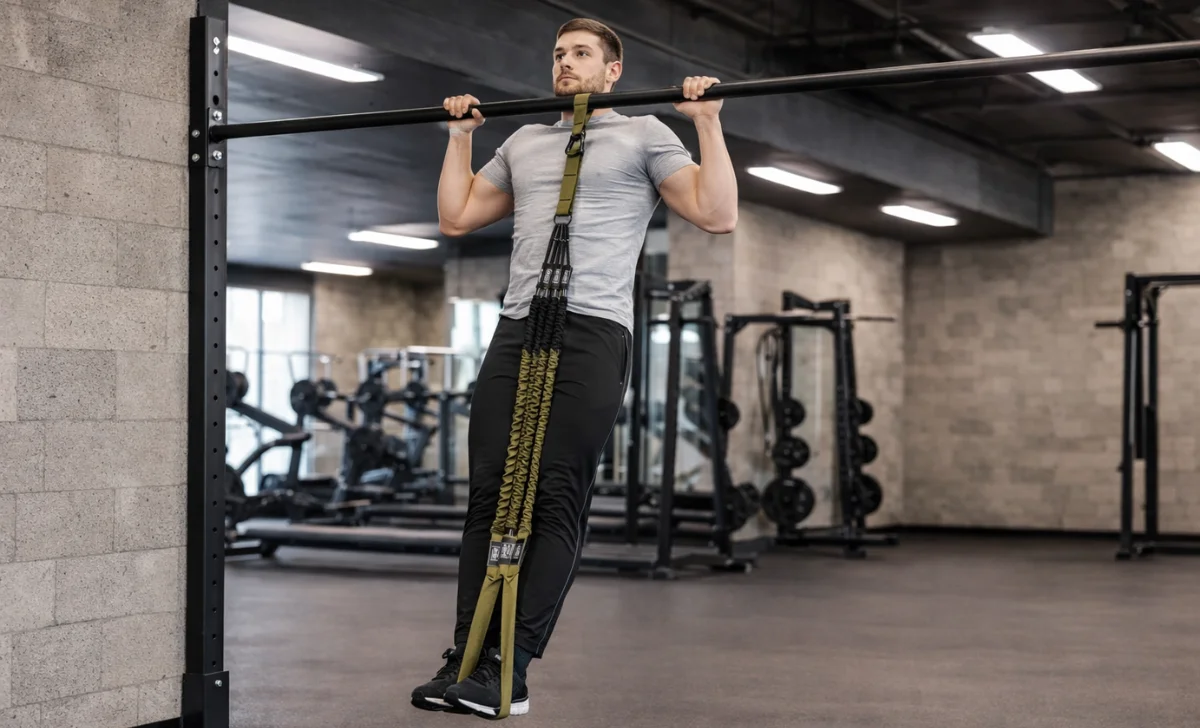
Pull-up helper bands offer an effective solution for anyone who struggles with traditional pull-ups but wants to build upper body strength at home. Despite being simple pieces of elastic, these versatile tools can transform your workout routine by providing adjustable resistance that grows with your strength.
Stretch bands for pull-ups function as a personal training assistant, making challenging exercises accessible regardless of fitness level. They need very little room and work for lots of workouts besides helping with pull-ups. Different from large workout machines, these bands fit in a drawer when you’re done using them.
Why Pull-Up Bands Work Great for Exercising at Home
Pull-up helper bands have become a practical solution for home fitness, delivering results without the time, cost, and space demands of traditional gym equipment.
Save time and skip the gym
Preparing for the gym, commuting, and waiting for equipment takes time. Pull-up bands remove these barriers, allowing quick transitions into effective workouts. Stretch bands for pull-ups make it easy to train on your schedule, whether you have five minutes between meetings or a short window at the end of the day. This allows you to add them to your packed daily routine without trouble.
They also offer clear financial benefits. A quality set costs far less than a gym membership and provides access to dozens of exercises without recurring fees. A single set of resistance bands can support a full-body workout.
Bands also allow precise load control. Unlike machines with fixed increments, stretch bands for pull-ups enable small resistance adjustments that better match your strength.
Minimal space and equipment needed
Pull-up helper bands take up very little space and store easily in a drawer or bag, making them ideal for small homes or apartments.
Their portability is another advantage. Bands can be used at home, outdoors, or while traveling, helping maintain consistency. Having accessible equipment nearby often makes regular training easier to sustain.
Bands can also replicate cable-style exercises. With a door anchor or stable surface, movements like lat pull-downs, face pulls, and tricep press-downs become possible in a small space.
Great for all fitness levels
Pull-up helper bands work well across all stages:
- Beginner aids–reducing lifted body weight
- Intermediate tools–allowing gradual reduction of assistance
- Advanced resistance–adding difficulty to bodyweight exercises
They support proper form through a full range of motion, helping beginners avoid partial reps or poor technique. This is especially useful for learning shoulder positioning and movement patterns.
Bands can also suit people rebuilding strength with controlled resistance. Their smooth tension tends to reduce joint stress compared to free weights. Overall, pull-up helper bands provide a flexible, efficient approach to home training while minimizing space needs.
Types of Pull-Up Helper Bands and How to Choose
Choosing the right pull-up helper bands starts with understanding available types and how they match your needs. Stretch bands for pull-ups typically come as loop bands or tube bands. Loop bands are closed, flat loops without handles, while tube bands are cylindrical and usually include handles.
Loop bands offer greater versatility and anchor easily to pull-up bars, making them better suited for assisted pull-ups. Tube bands work well for pressing and pulling movements but are less adaptable overall. High-quality loop bands made from layered flat latex also tend to be more durable and stretch further without snapping, which matters for overhead exercises.
Pull-up helper bands are usually color-coded by resistance:
- Light bands (10–35 lbs) – for cleaner form and light assistance
- Medium bands (30–60 lbs) – for intermediate strength levels
- Heavy bands (50–125 lbs) – for beginners needing significant help
- X-Heavy bands (65–175 lbs) – for complete beginners or heavier users
Resistance choice depends on current strength. Thicker and wider bands provide more assistance, which is why width matters alongside color.
The materials used to build them greatly affect their lifespan. Natural latex or rubber offers better elasticity and tear resistance than synthetic materials, while layered construction improves durability and helps bands maintain consistent tension over time. Thicker bands usually last longer, though they may feel less comfortable for some movements.
Regular inspection for wear is important. Protecting bands from prolonged sun exposure and extreme temperatures helps extend their lifespan.
Beginner to Advanced: Pull-Up Band Workout Progressions
Progressing from your first assisted pull-up to performing multiple reps unassisted requires a strategic approach. Pull-up helper bands create the perfect pathway for methodically building strength through gradual progression.
Assisted pull-ups for beginners
Beginners should start with a thicker band that provides sufficient assistance–ideally allowing you to complete 5–10 quality repetitions. Selecting the right band is crucial; if you can easily perform more than 15 reps, the band is too strong and doing most of the work for you. Conversely, if you can’t manage at least 5 reps with good technique, choose a thicker band.
Form matters tremendously during assisted pull-ups. Keep your shoulders retracted throughout the movement and pull until your chin clears the bar. Lower yourself slowly with control rather than dropping down, as this controlled descent builds crucial strength.
According to Harvard Medical School, strength training with resistance places healthy stress on bones through pulling and pushing forces. This process helps stimulate bone-forming activity and supports long-term bone density, not just muscle strength.
Most beginners can expect to progress to a lighter band in approximately 12 weeks with consistent practice. For best outcomes, do pull-up exercises two to three times each week with a break day in between.
Negative reps and static holds
Negative pull-ups powerfully complement band-assisted training. This technique involves jumping to get your chin above the bar and then lowering yourself down slowly–taking about 8 seconds per repetition.
To perform negatives:
- Use a chair or step to reach the top position
- Control your descent with minimal band assistance
- Perform 3–5 sets of 3–5 repetitions
Static holds likewise build foundational strength. Position yourself at various points in the pull-up range and hold for time, gradually increasing duration as you strengthen. These isometric contractions develop stabilizer muscles essential for unassisted pull-ups.
Combining bands with bodyweight exercises
An effective progression technique involves “drop sets” where you begin with band-resisted pull-ups (band underneath adding resistance), perform 3–6 reps, then immediately transition to band-assisted pull-ups until failure. This method helps tire your muscles fully and encourages them to grow.
Another strategy involves gradually adjusting your foot position in the band. Standing with both feet creates maximum assistance, while using only one foot reduces help. Additionally, positioning your feet further forward from the bar decreases assistance, creating another subtle progression method.
After mastering these techniques, many dedicated practitioners can achieve their first unassisted pull-up within 6–12 months of consistent training. Remember that volume–total reps performed–matters more than maximum repetitions in a single set when building pull-up strength.
Full Upper Body Routine Using Pull-Up Bands
Transform a single set of pull-up helper bands into a complete gym with this comprehensive upper body routine. These versatile tools effectively target every major muscle group with proper form and technique.
Back: Banded rows and pull-aparts
For a powerful back workout, begin with banded rows. Stand in the middle of your band with feet shoulder-width apart, grip the ends, and pull toward your waist while activating your lats and keeping your elbows close to your body.
During the exercise, keep your back straight and tighten your stomach muscles.
Band pull-aparts work well for strengthening your upper back and fixing how you stand. Hold the band with straight arms at shoulder height and pull apart until the band touches your upper chest, feeling your shoulder blades squeeze together.
Chest: Banded push-ups and flys
Elevate standard push-ups by placing the band across your back and anchored under your hands in plank position. This adds more strain at the highest point of the exercise, working your chest and arm muscles better.
Banded flys isolate the chest muscles beautifully. Anchor your band to a stable object at chest height, face away while holding both ends, and bring your hands together in front with slightly bent elbows.
Arms: Curls, extensions, and kickbacks
For biceps, stand on the middle of your band, grasp the ends with palms facing forward, and curl upward. Initially keep your elbows fixed at your sides throughout the movement.
Target triceps with overhead extensions by securing the band above you and extending your arms downward. Alternatively, try kickbacks by hinging forward and straightening your arms behind you.
Shoulders: Lateral raises and overhead press
Lateral raises strengthen the deltoids primarily. Put the band beneath both feet, grip the handles next to your body, and lift your arms up to your shoulders.
Complete your routine with overhead presses. Stand on the band, bring handles to shoulder level, and press upward until arms fully extend. This combined exercise works all parts of your shoulder area at the same time.
Conclusion
Pull-up helper bands are versatile, affordable tools that work well for home training. They adapt to different strength levels and fit easily into small spaces.
Progress from assisted to unassisted pull-ups takes time, but proper band selection and consistent technique make steady improvement achievable. Choosing resistance that challenges you without sacrificing form helps build a strong foundation for long-term progress.